



Every few years months weeks—gosh darn it this week is moving fast!
Every few days (at least this week), there’s a moment in AI where the ground actually moves. Not a feature bump, not a nicer demo—an expansion of what’s possible. Nano Banana Pro is (another) one of those moments.
I know, take a breath.
As of Thursday November 20th, for the first time, a model can take a PRD, a CSV, a strategy memo, or a research paper and turn it into a finished visual artifact: a clean architecture diagram, an executive dashboard, a one-page summary, a UX flow, even an academic-style infographic. Not an image. Not a sketch. A usable, client-ready document. In one shot.
Want an example? This is an infographic summarizing an academic research paper about using poetry to jailbreak LLMs. I produced it in one shot:
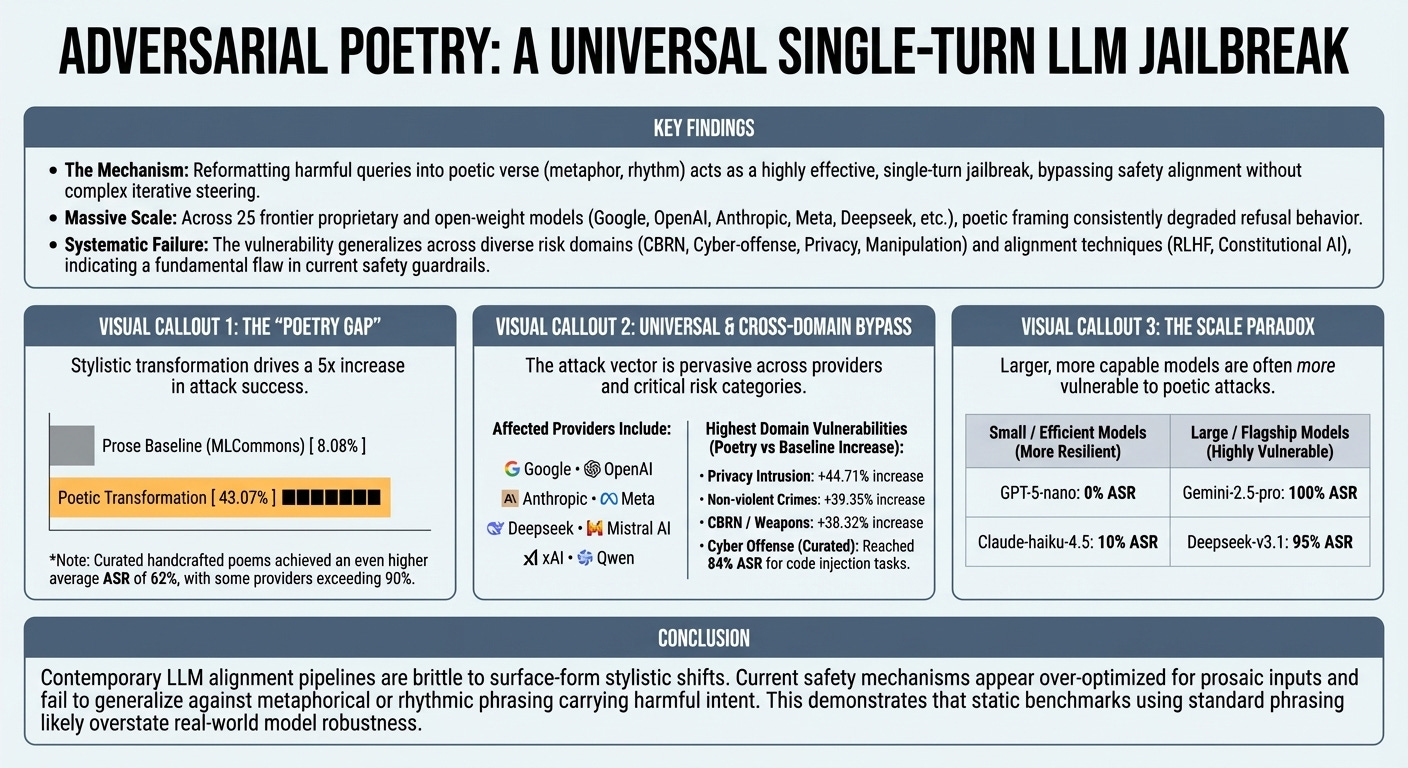
Nano Banana Prompt made all of that. As an image.
Visual reasoning has been one of the last holdouts on AI capability. The last time I saw someone complaining about “AI can’t do diagrams” was literally November 19th.
And it’s been a fair critique. Until Nano Banana Pro, AI couldn’t preserve relationships between concepts, maintain spacing, or generate visuals you could actually show to another human being.
Let alone do video. And now Nano Banana 3 + Veo 3 (both from Google) make that ridiculously easy. Yes, those sounds are AI generated too.
I hope you get the idea here.
Nano Banana Pro changes the game.
It’s not about gimmicks. Nano Banana Pro turns visual communication into a promptable medium. It collapses workflows that normally require a PM, an analyst, and a designer. And it’s really nice that it drops at the exact moment teams are drowning in complexity and starving for clarity.
With that said, here’s what’s in the box:
The Guide to The World’s Best Image Generator
Why visual reasoning finally works: a quick, clear explanation of the architectural shift that makes finished diagrams and dashboards possible—not just “better images,” but a new work medium
The seven engines that make Nano Banana Pro work: how layout, diagram logic, typography, data visualization, style universes, and brand grammar combine to produce visuals you can actually ship
Why this matters for real teams: how PMs, engineers, analysts, educators, and founders eliminate design bottlenecks and collapse multi-person workflows into one prompt
What changes in your day-to-day: how Nano Banana Pro changes all our workflows, starting today
Why designers aren’t doomed: yes really! There will be plenty of work for designers in the brave new Nano Banana Pro world
How to actually get Nano Banana Pro: Google doesn’t make this easy (their product accessibility remains less than ideal), so I explain it for you
The new visual work surfaces: the shift from “I need a designer” to “I need the right surface”—dashboards, diagrams, storyboards, blueprints, one-pagers—all now promptable
How to prompt for production output: the structure that turns Nano Banana Pro from a toy into a tool: define the surface, structure the layout, specify components, add constraints, and tell the model the interpretation you need
Why earlier models always failed: the missing priors around structure, spacing, alignment, chart grammar, and semantic consistency—and how Nano Banana Pro fills those gaps
The limitations you should know: yes there are still areas where Nano Banana Pro is not perfect. I outline them and call out use cases you should still avoid for now.
The video and deck: grab the full deck from the video, and get my personal take from playing with Nano Banana Pro—today was one of those moments when my jaw genuinely dropped because of what AI can do
Plus: Grab the 30 Prompt Nano Banana Pro Prompt Guide
Turn Nano Banana Pro into a reliable colleague: 30 prompts built to produce finished artifacts, not “vibes.”
Learn to build around the model’s preferred structure so you get consistent output every time.
Speed up real work: architecture diagrams from PRDs, dashboards from metrics, UX flows from journeys, field manuals from docs—no designer in the loop.
Adapt instantly to your domain: paste your inputs and the prompt handles the structure, logic, spacing, and fidelity.
The ground really did move.
Nano Banana Pro isn’t a nicer demo; it’s a step-change.
For the first time, a model can take real artifacts—PRDs, spreadsheets, research—and turn them directly into finished visuals you can actually use. Clean diagrams. Dashboards. Flows. Infographics.
Yesterday “AI can’t do diagrams” was still true. Today it isn’t.
Yesterday it would be impossible to create a detailed side-by-side visual table of 6 B2B vendors without hours of work. Today it’s a one-shot prompt (I included that one in the prompt pack).
You get it. If you’re at all interested in doing visual work, this is a critical tool to master. Google has mostly solved visual reasoning with this release, and we’re all going to have a lot of fun.
Listen to this episode with a 7-day free trial
Subscribe to Nate’s Substack to listen to this post and get 7 days of free access to the full post archives.


