


Anthropic already counts more than half the Fortune 500 as customers generating at least $100,000 in annual revenue. Among the publicly traded companies in that group, spending with Anthropic still averages less than one dollar for every thousand dollars of total expenses.
Anthropic reported $16.3 billion in revenue for the first half of 2026. It has built an enormous business while remaining a very small purchase inside some of the world’s largest companies.
Anthropic’s initial S-1, filed October 26, reports both figures. The filing, which companies submit before going public, compares those customers’ spending with Anthropic against their total expenses in the September quarter.
I think Anthropic could become one of capitalism’s most successful businesses by selling intelligence that makes a customer’s existing people and capital more productive, then makes additional projects worth attempting. Some of those projects are too expensive today. Some are too difficult. Some have never made it into a budget because nobody considered them practical.
I’ve written about intelligence as a new economic input. Customers learn how to use it by putting it to work. They discover additional uses, build more capable systems, and reconsider projects they once dismissed as too expensive. Anthropic’s revenue grows with that activity. Its research and computing bills grow with the effort to support it.
The first purchase says little about what follows
Today’s AI budgets reflect what companies have learned how to do with AI so far. As employees gain experience and models improve, more work becomes practical. The company starts planning around capabilities it didn’t have when it set the original budget.
A hundred thousand dollars is a real customer relationship for Anthropic. For a Fortune 500 company, it can still be a small deployment in a small part of the business.
The filing’s threshold is at least $100,000 in revenue over the preceding twelve months. As of September 30, more than 11,900 customers met it, up from more than 950 a year earlier. More than 1,900 had reached $1 million, and approximately 250 had reached $10 million. Within the Fortune 500, the customer list includes all ten of the largest banks and nine of the ten largest pharmaceutical companies. Those relationships have room to develop in very different directions.
There’s already a considerable difference in how intensively these companies buy. Anthropic’s ten largest Fortune 500 customers spend, on average, more than eight times the qualifying group’s average share of expenses. Even that top group’s average remains below 1% of total expenses, using the filing’s publicly traded customer comparison.
The opportunity is that intelligence can help a customer’s existing spending accomplish more. More intelligence spending can pay for itself by improving the use of resources the business already has. Anthropic only needs to capture part of that additional value.
Anthropic reports roughly 900% net revenue retention: existing customers collectively generated about nine times as much revenue in the September quarter as they did a year earlier.
Those accounts can grow as more employees use Claude, more departments adopt it, and teams give it more demanding work. A customer that builds Claude into a product can also buy more intelligence as that product gains users.
The growth is spreading across the customer base. Customers outside Anthropic’s top five supplied approximately 79% of September-quarter revenue, up from approximately 64% in the March quarter. Each of its top five customers also reached a revenue record in the September quarter.
The bill follows the work
Total customer spending fell approximately 20% in the two weeks ended January 2, 2026, compared with the two weeks ended December 19, 2025. Anthropic connects the pattern to slower customer activity over the holidays, including code freezes.
People did less work, and the bill got smaller.
About 80% of first-half revenue was consumption-based: customers paid according to usage. Their activity continued to affect the relationship after the purchase. Consumption pricing lets an account grow when a customer finds additional work and lets spending contract when that work pauses.
For spending to keep growing, customers have to find enough useful work to justify their bills.
Novo Nordisk began its NovoScribe project in 2023 with clinical study reports. Statisticians produced trial results, tables, and figures. Technical authors assembled the material into report templates, followed by extensive quality checks. The system Novo built retrieves relevant approved text and statistical outputs, uses models to draft report sections, and preserves the connection to source material so authors can verify the result. Novo’s project leaders describe an architecture using Claude 3, Amazon Titan, and a private ChatGPT deployment.
Novo reports a 90% reduction in clinical study report writing time, with people reviewing and approving the documents. The team has extended NovoScribe into device protocols and patient materials. It now uses Claude Code to help domain experts prototype ideas within a team of eleven.
Novo supplied the trial results, approved language, authors who understood the reports, and people responsible for accepting them. The application connected those resources and made their work faster. The team then extended what it had built to other documents the business needed.
Across Anthropic’s customer base, use increasingly spans both its platform and its applications. In the September quarter, more than half of customers generating at least $100,000 in trailing annual revenue used both Claude Platform, which lets them build with the models, and at least one of Anthropic’s own applications. That proportion was about 30% in the last quarter of 2025.
Counting employees misses part of what those customers are buying. A company can use Claude to assist its people, run a recurring process, or supply intelligence inside a product it sells. An account can grow without adding employees.
Research can change what customers attempt
Novo also plans to test a broader role for Claude. In its September 16 announcement, the company said it would test Claude Science in selected research and development workflows, work with Anthropic on discovery challenges chosen by its scientific and computational teams, and use frontier models for software development.
Novo is moving from using AI to describe completed research toward using it to help conduct research.
Anthropic has also used Claude to make scientific tools cheaper to run. In its September work on biomolecular modeling, the company reports optimizing more than thirty specialist biological models. Across the tasks studied, it reports average speedups of nearly twofold with identical outputs, and roughly fourfold with a small precision tradeoff. It released the optimized code for scientists to use.
Cheaper calculations let researchers evaluate more possibilities with the computing resources they have. They can test ideas that previously cost too much to investigate. As more projects become worth pursuing, the work available for AI expands.
The S-1 describes Anthropic hiring industry experts, building a molecular biology lab, and acquiring Coefficient Bio to strengthen its research. Its stated aim is to build agents that assist scientists across drug development. In an October 27 research update, Anthropic says work with drug-development partners has exposed model limitations and already changed its priorities for model improvement.
Working alongside scientists gives Anthropic specific problems to solve. It can direct research toward capabilities that make more scientific work possible, then sell those capabilities to a much wider group of customers.
Research can also make existing work less expensive. Anthropic says Opus 5.5 reduced customers’ cost per task by approximately 40% compared with Opus 5, through a combination of pricing and task efficiency. If customers do the same work, their bills fall. If enough additional work becomes worthwhile, their total spending can rise. In my own use, greater efficiency has given me more work to hand to these tools.
Better intelligence can change the supplier’s economics too
In the second quarter of 2026, Anthropic produced roughly 14.7 times the revenue it generated in the same quarter a year earlier, while compute and infrastructure expense roughly quadrupled.
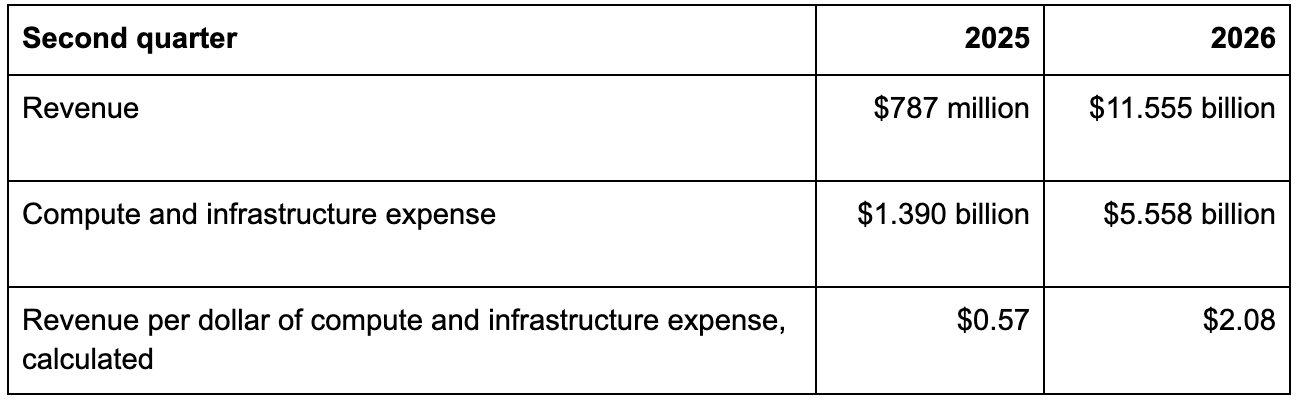
Revenue per dollar of computing expense more than tripled, calculated from the quarterly financial tables. That computing bill pays for research, model development, serving customers, and internal use.
Anthropic’s work on computing efficiency reaches across training, customer use, and hardware. Its researchers work on ways to train better models with a given amount of computing power and to serve them with fewer resources. Its engineers improve the use of available capacity. The company also runs workloads across several chip families, giving it more options for matching a job to suitable hardware.
Those improvements could allow the customer to pay less for a useful task while Anthropic earns more from the computing resources it has purchased.
Anthropic says Claude also assists the research and engineering behind subsequent models. Helping engineers make models more efficient can free computing capacity for customer work. Helping researchers develop useful capabilities can expand the work customers want to buy.
Better models come with a research bill
Anthropic has to keep funding the research that makes customers want its next generation of models.
Anthropic’s gross margin was approximately 85.4% for the first half of 2026, up from approximately 39.5% for 2025, calculated from the functional expense table in Note 8. Revenue substantially exceeded the costs of serving customers. From that gross profit, Anthropic also had to fund research and distribution. Research and development alone cost $9.741 billion in the first half, equivalent to 59.8% of revenue.
Research keeps the existing product competitive and opens markets for new capabilities. More than 80% of September-quarter revenue came from model versions released during the preceding six months. A better model can keep a customer buying intelligence for familiar tasks while giving that customer a reason to attempt different work. The move from scientific documentation into scientific research expands what Anthropic can sell to life-sciences customers.
The second quarter produced $974 million in operating profit under standard accounting rules, including research expenses and stock compensation. For the first half as a whole, Anthropic reported an operating loss of $693 million. Sustaining profitability depends on what customers keep buying as research and capacity requirements change.
Forty-eight percent of first-half revenue came through cloud marketplaces. Those channels let customers reach Claude through providers with which they already have relationships. Anthropic retains the direct customer contract and establishes pricing, but it reports the revenue gross, before channel fees. Channel partner costs appear in sales and marketing rather than cost of revenue.
In the Note 8 functional table, total first-half sales and marketing expense was $3.808 billion, or about 23.4% of revenue. Channel fees are one part of that bill. Anthropic pays these expenses, along with research, out of its gross profit.
Existing cloud relationships can make it easier for a customer to buy. They also affect what Anthropic retains from the sale and its dependence on partners, some of which supply infrastructure, provide capital, and sell competing models.
When the supplier enters the customer’s industry
Anthropic is now developing drugs as well as supplying tools to drug developers.
In its October 27 update, Anthropic announced that it had acquired Mithril Medicine, a one-person company with two rare muscular-dystrophy programs. It is continuing those programs internally. The work is preclinical, before human trials.
Anthropic is hiring to buy, invest in, and partner with AI-native companies across its customers’ industry. Its Corporate Development Lead, Life Sciences job posting covers drug discovery, clinical development, regulatory and medical writing, laboratory automation, and healthcare data infrastructure.
One of Anthropic’s customers, Bluenote, sells Claude-powered agents for regulatory documentation and other life-science workflows. Its system uses Claude as the default model for scientific and technical documents while supporting other models. The work Bluenote sells sits inside the territory Anthropic is hiring someone to pursue.
A pharmaceutical company has to assess a supplier’s possible long-term role in developing medicines. A software company faces a more immediate product decision: how much of what it sells could become a standard feature of the model supplier’s own application? Better Claude models can make Bluenote’s product better while bringing Anthropic closer to being able to offer similar work itself.
Anthropic’s commercial data policy says commercial inputs and outputs aren’t used for model training by default. A supplier can protect confidential data and still build a competing business.
For the customer, this puts more weight on the capabilities it builds and controls. NovoScribe combines purchased model capabilities with Novo’s information, processes, and domain judgment. Improving those internal resources can strengthen Novo’s business. When rivals can buy the same AI capability, the advantage comes from what a company does with it: the experiments it chooses, the information it brings, and how well it turns the results into a product.
Novo is choosing to work more closely with Anthropic on research while bringing its own capabilities in testing, regulatory approval, manufacturing, and distribution. Anthropic has years of development work ahead of its own drug programs. Its S-1 describes the costly and uncertain path from a drug candidate to revenue, including activities beyond its historical experience.
Better models can make customers want more, while a supplier’s entry into their industry can make them more selective about what they delegate. Trust, control, and competitive overlap can affect adoption alongside capability and price.
Customer learning must keep up with capacity commitments
The speed at which customers expand affects Anthropic’s computing needs. The company has to reserve capacity before it knows exactly how fast customers will put it to work.
The company generally procures its long-term computing supply 12 to 18 months before it becomes available. Capacity arrives in discrete steps, joining a shared pool that supports research, model development, customer workloads, and internal use. Costs can begin before the additional capacity reaches its full revenue potential. If demand exceeds the long-term supply, Anthropic may buy short-term capacity at a higher price.
NovoScribe shows why the timing varies. In the team’s account, adapting the system to patient booklets took little time. Device protocols required months of work to ingest unstructured legacy data. Novo, on one platform, faced very different preparation before it could extend the system to another kind of document.
In my experience, workflows inside businesses have distinctive fingerprints. They can be poorly documented, configured in unusual ways, and far more different in complexity than they appear from the outside. The person who knows why an exception exists may be more important to a successful deployment than another increment of model capability.
To help customers implement AI, Anthropic has committed $100 million to Claude Frontier Academy, with a goal of training 10,000 engineers by the end of 2027. Participants are supposed to lead deployments in their own organizations. Anthropic also works through Applied AI teams and consulting partners.
Training a customer’s engineers can increase that customer’s ability to find and implement useful applications. The first successful deployment can leave people, connections, and knowledge in place for the next one, which gives Anthropic a commercial reason to invest in engineering skills beyond its own payroll.
The amount of assistance customers need will affect how quickly this scales. Engineers working directly with a customer can accelerate adoption, and some expansions will keep requiring that help. Training the customer’s own people gives Anthropic another way to grow deployment capacity. The pace determines both the customer’s implementation costs and how quickly reserved computing capacity can support revenue.
Customers can also find uses faster than planned, leaving Anthropic paying more for short-term supply. Underused additions and expensive extra capacity can both compress margins.
Anthropic also expects more of its infrastructure investment to require significant payments before the computing capacity becomes operational. That draws cash out of the business before the new capacity earns revenue. The filing says cash use may increase even if financial performance improves.
What the customer does next
Customers build their own ability to use intelligence as they deploy it. They connect information, develop judgment about the results, and learn where the next useful application might be. Better models then give those people more to work with. That is why I expect demand to grow well beyond today’s AI budgets.
Anthropic’s growing ambition makes the customer’s choices more consequential. A company needs to decide which capabilities to develop internally and which to buy from a supplier that may enter its industry. Its own knowledge, operating experience, and ability to bring products to market become more valuable as powerful AI becomes widely available.
Anthropic’s opportunity grows when a customer makes better use of the people and capital it already has. It grows again when that customer sees a project it couldn’t previously justify and decides it’s now worth doing. The most interesting part of the next AI budget may be the work that was never in the last one.
Nate’s Library MCP
Paid subscribers get my entire library inside their AI.
Nate’s Library MCP is a read-only MCP server that gives your AI direct access to my entire published content library. Connect once, and then the archive just shows up in your normal AI conversations. You ask your AI a question during your actual working session and it pulls from everything I’ve published to answer it.
Setup takes just a few clicks.
Join the Slack →
It’s where I’ll be sharing things between articles, where you can get help on builds in real time, and where the fastest conversations in this community are already happening. I’ll see you in there!
If you have any issues connecting to my MCP or Slack, please email support@natebjones.com.
Related reading
Enterprise AI has an implementation problem: the six things that have to be true before AI changes a workflow, and why most companies have built two.
Opus 5.5 makes me want to give Claude more work: which jobs cost less on Opus 5.5, with a 3-prompt guide to check before you move them.
Why AI is turning Big Tech into an industrial business: what a capacity crunch means for your AI vendor contract, with 3 prompts to fix it before your budget meeting.
AI is changing what your business can afford to be: how cheaper agents point to different customers, different offers, and a different answer to where a company earns its money.


