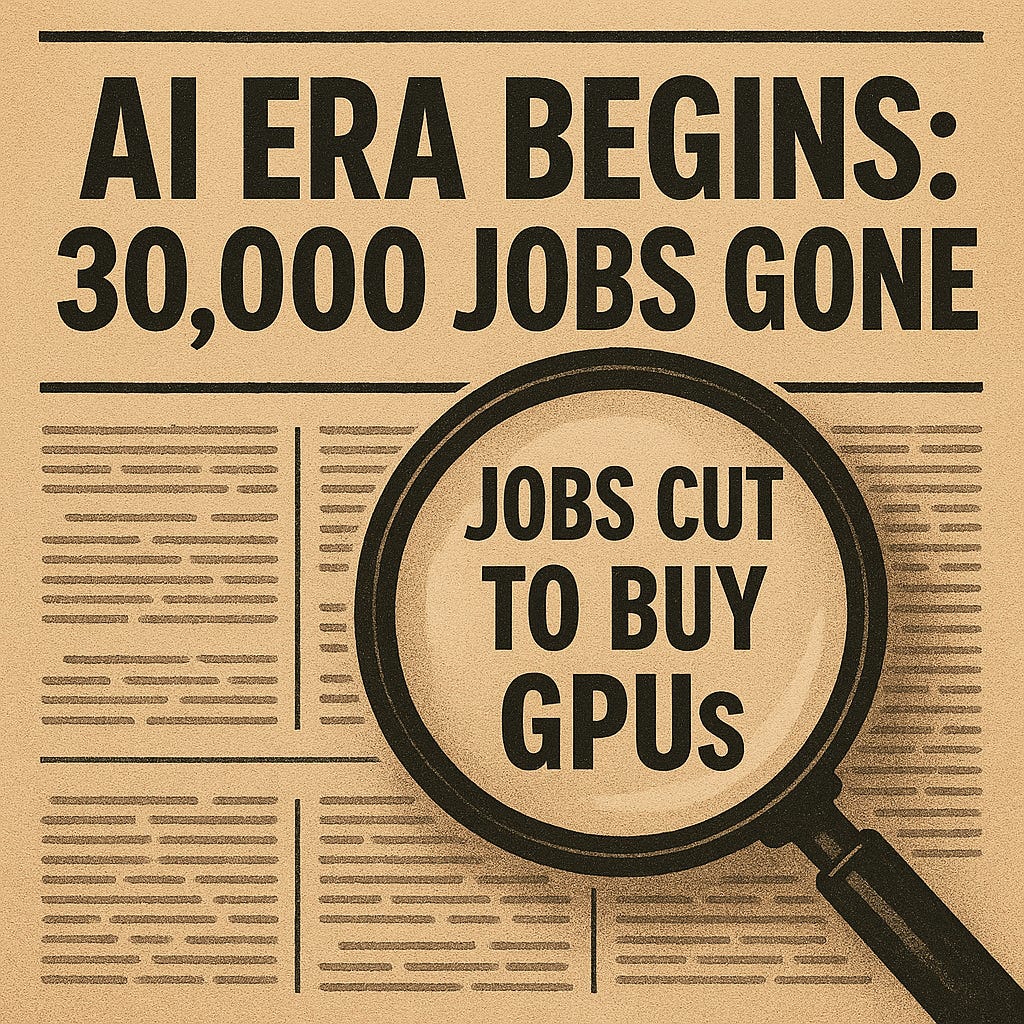
Amazon dropped 30,000 people this week, and every headline I’ve read tells the exact same story: your job is next, AI is taking over, welcome to the future.
The coverage has been relentless. Article after article explaining how Amazon is “embracing automation” and “restructuring for an AI-first world” and how this is just the beginning of mass job displacement across every industry. The media is absolutely in love with this narrative.
And look, I get it. It’s a compelling story. It’s scary. It fits the moment.
But it’s wrong.
Not wrong because layoffs aren’t brutal. They absolutely are. But wrong about why this happened. And the gap between what actually happened and what everyone’s reporting reveals something important about how we’re all thinking about AI right now.
So let me walk you through what’s really going on. Because I spent years at Amazon, and I know exactly how this company makes decisions about money.
Grab the prompt to read the next AI story
I’ll link it and talk about it down below, but if you want to get the prompt that will help you decode future AI claims, it’s right here. In fact, there’s two of them! One for Perplexity to do research, one for ChatGPT or another reasoner model to think through the real story with you.
The AWS Problem Everyone’s Ignoring
First thing you need to know: Amazon doesn’t actually make money selling you stuff.
I know that sounds crazy. You think “Amazon” and you think of the everything store, the cardboard boxes showing up on your doorstep, the retail empire. But retail margins are terrible. Amazon could sell twice as much stuff tomorrow and it wouldn’t move the needle on profitability.
The actual money comes from AWS. The cloud computing business is the whole game. Every quarter, Wall Street looks at exactly one number: AWS growth rate. That number is everything.
And right now? That number is headed in the wrong direction.
AWS growth has been decelerating for years. They’re down to 18% year-over-year, and while that still sounds impressive, Wall Street hates the trend. Especially because Azure and Google Cloud have been closing the gap fast, powered almost entirely by AI infrastructure.
When companies want to build AI products today, they’re thinking about Azure. They’re thinking about Google Cloud. AWS has fallen to a distant third place in the race that matters most for their future.
So Amazon has a problem. They need to prove they’re still serious about AI. And to do that, they need Nvidia GPUs. Lots of them, and they need them now.
These aren’t normal chips. Each one costs about as much as a decent car. And to compete at scale in AI infrastructure, you need thousands upon thousands of them.
But here’s where it gets interesting from a finance perspective: Amazon can’t afford to let this GPU investment damage AWS margins. Those margins are literally the only reason the company has its current valuation.
So you’ve got a massive capital expenditure problem. You need to buy an enormous amount of expensive hardware, but you can’t let it hurt your margins.
What do you do?
You cut somewhere else. And the biggest line item you can cut is salaries.
Amazon’s Real Problem: They Need GPUs. Now
Amazon didn’t lay off 30,000 people because AI was already doing their jobs. They laid off 30,000 people because they needed the cash right now to buy GPUs and catch up in the AI cloud race.
That’s the whole story.
Now obviously, that doesn’t sound great from a PR perspective. So instead, Amazon positions it as forward-thinking efficiency gains through AI automation. And tech journalists, who generally don’t understand enterprise cloud economics, run with it.
But anyone who’s actually worked inside Amazon (and I have) knows that’s not reality. The internal systems are not some gleaming automated wonderland. They’re held together with duct tape and manual processes and workarounds that would shock you if you knew about them.
There is no magical AI automation system that Amazon just deployed that eliminated 30,000 roles overnight. The technology isn’t there yet. The people who remain at Amazon are stressed and overwhelmed trying to pick up the work.
Want to know how I know? Look at where the cuts landed.
MGM took a big hit. The Hollywood studio Amazon acquired a few years ago. If Amazon had really made some breakthrough in AI automation that eliminated tens of thousands of jobs, do you really think they applied it to MGM first? Of course not. MGM got cut because it’s an area where Amazon can afford to operate leaner for a while without it directly impacting the AWS competitive situation.
The cuts are happening in places where Amazon thinks they can take a risk on getting less done with fewer people, because they desperately need to reallocate that money to GPUs.
The Contradiction Hiding in Plain Sight
And here’s where this gets really frustrating for me.
Everywhere I look, I’m seeing two contradictory narratives at the same time:
AI is automating jobs at massive scale (look at Amazon!)
AI is a bubble and we’re all being fooled by hype
Pick one. You can’t have both.
If AI is genuinely automating jobs at the scale these headlines claim, then by definition it’s not a bubble. And if we’re actually in a bubble, then companies wouldn’t be able to credibly blame layoffs on AI automation. The automation wouldn’t be working well enough to justify the cuts.
So which is it?
Well, let’s look at the actual demand signals. Amazon has a 25% shortfall in GPUs right now. Demand is vastly exceeding supply. They literally cannot get enough chips to serve all their customers who want AI infrastructure. Azure and Google Cloud are in the same position, massively expanding data centers and still can’t keep up.
When you have customers lined up out the door and you physically cannot serve them all because you don’t have enough hardware, that is not a bubble. That is genuine demand for genuine value.
So no, we’re not in an AI bubble. And no, AI hasn’t automated away 30,000 Amazon jobs.
What actually happened is that Amazon needed cash to buy GPUs to compete in AI cloud, and they got that cash by cutting costs elsewhere. It’s corporate finance, not technological revolution.
But corporations love the automation story because it makes them sound innovative. Wall Street loves it because they understand “efficiency gains.” And tech journalists love it because it’s dramatic and scary and gets clicks.
So everyone runs with a narrative that doesn’t hold up under five minutes of scrutiny.
How to Think About What’s Coming
Look, none of this analysis makes losing your job any easier. Getting laid off is brutal. I’ve been through it.
If you’re one of the 30,000 people who got cut this week, the reason doesn’t change your immediate situation. You still lost your job either way. And to all the Amazon alumni reading this: you’re going to land somewhere good. The community has your back.
But for everyone else trying to understand what’s happening, the reason matters a lot.
Because the story you believe determines how you respond.
If you think AI is already automating jobs at massive scale, the rational response is panic. Pull back. Hunker down. Stop investing in learning new things because what’s the point if it’s all getting automated anyway.
But if you understand that we’re in a period where companies are making huge infrastructure bets on AI and sometimes funding those bets by cutting costs in other areas, the rational response is completely different.
It’s to recognize that AI is creating real value (the GPU shortage proves that) but the technology isn’t mature enough to eliminate most roles yet. Companies are positioning for a future that’s coming, and that positioning creates short-term chaos as they reallocate resources.
The smart move isn’t to panic. It’s to understand what’s actually valuable about AI, where the technology actually works today versus where it’s still falling short, and how to position yourself to benefit from the transition.
The people who understand what’s really happening will make much better decisions than the people who buy whatever narrative is trending on Twitter.
How to Read Layoff News Without Losing Your Mind
If you want to get better at cutting through the spin when companies announce layoffs, I built something that might help: Tech Layoff News Decoder.
It walks you through the questions that actually matter: What’s the financial pressure? Where specifically are cuts happening? What’s the timeline? What’s the competitive context?
Because the official story (whether it’s “AI automation” or “efficiency improvements” or “strategic realignment”) is almost never the full truth. You have to look at the money, the competitive dynamics, and the capital allocation to figure out what’s really going on.
In Amazon’s case, following those questions leads you straight to the GPU problem. The cuts are in areas that don’t help AWS compete in AI. The timing aligns with massive infrastructure spending. The automation narrative doesn’t match the actual state of the technology.
Follow the money, not the PR.
Amazon didn’t fire 30,000 people because robots took their jobs. They fired 30,000 people to free up cash to buy the hardware they need to stay competitive in AI cloud.
It’s not a story about AI apocalypse. It’s a story about a company that fell behind and is trying to catch up.
Next time you see a headline screaming about AI and layoffs, ask yourself: does this narrative actually hold together? Can these claims all be true at once? Or is someone trying to sell you a story that sounds good but falls apart when you think about it?
Because we’re getting a lot of stories right now. And most of them are wrong.
Good luck out there. Don’t get fooled.
Get the Data on this story here
I prepped a public Perplexity research project showing the larger structural factors driving the AWS thesis I present here. These shouldn’t surprise anyone in the space. I also have a few contacts from my years at Amazon who provided background perspective.